The Life Drivers Six Archetypes Pull & Turn Governance Plumb Line Leadership Facets Vocation Sixteen Settled Truths The Dialogue The AC Arc

The Framework

The architecture of an aligned life.

Nine layers of measurement, one coherent portrait: what runs you, how well you govern what runs you, and where the specific formation invitation is asking you to walk next.

Layer 1

The Life Drivers, the engine beneath every life decision.

Every human being is powered by three motivational primaries: Ambition, Appetite, and Approval, sometimes shorthanded as the Three A's. Every person carries all three. What differs is which one leads, which follows, which runs quietly in the background, and whether each is governed by the person or governing the person.

Each of the three splits into two subscales that reveal how the drive is composed inside a specific person, and where the intervention point sits when the drive begins to run the person rather than the other way around.

Driver 01

Ambition

The drive toward achievement, significance, and impact. It is what gets you out of bed when there is a goal on the horizon.

GovernedDirected purpose. Meaningful work that serves others and builds lasting value.

UngovernedCompulsive striving. Identity fused with output. Rest experienced as failure.

Subscales: Purpose · Recognition

Driver 02

Appetite

The pull toward pleasure, comfort, stimulation, and experience. Often the driver most quietly running high achievers who do not think they have an appetite problem.

GovernedHealthy enjoyment. Presence, gratitude, capacity to savor life's gifts without being mastered by them.

UngovernedCompulsive consumption. Escape into stimulation. Pursuit for the sake of the pursuit.

Subscales: Stimulation · Hedonic

Driver 03

Approval

The need for acceptance, belonging, and relational security. The most socially acceptable of the three and the one most quietly running people when they are not paying attention.

GovernedHealthy connection. Attunement, empathy, deep relationships without losing yourself inside them.

UngovernedShape-shifting. Identity defined by others' expectations. Truth sacrificed for harmony.

Subscales: Relational · Social

Applied

How the drivers shape what we hear and say.

The Three Drivers are not only what people are governed by; they are how people speak and how people listen. Analyze anyone's collected writing (speeches, letters, sermons, memoirs) and the primary driver surfaces in the vocabulary they reach for, the images they build around, and the emotional register that lands. Historical figures and the people around your dinner table show the same pattern: language is driver-shaped.

Neuroscience adds the second half. We do not just speak from our primary driver, we hear through it. The same sentence, spoken to two listeners with different primary drivers, reaches them as two different messages. The speaker's intent is filtered through the listener's watchtower.

This is where much interpersonal conflict actually lives. A speaker communicating from Ambition is heard by an Approval-oriented listener as a threat to belonging, or by an Appetite-oriented listener as coldness. The speaker said one thing. The listener heard something the speaker never intended. Once you can name this pattern in real time, you can defuse it in real time.

Example · Reading a driver from a single paragraph

“It is not the critic who counts; not the man who points out how the strong man stumbles, or where the doer of deeds could have done them better. The credit belongs to the man who is actually in the arena, whose face is marred by dust and sweat and blood; who strives valiantly; who errs, who comes short again and again, because there is no effort without error and shortcoming; but who does actually strive to do the deeds; who spends himself in a worthy cause; who at best knows in the end the triumph of high achievement, and who at the worst, if he fails, at least fails while daring greatly.”

Theodore Roosevelt, Citizenship in a Republic, Paris, 1910

Vocabulary: counts, strives, does actually strive, spends himself, worthy cause, triumph, daring greatly.

Images: the arena. The doer marred by dust and sweat and blood. The cold and timid souls who neither know victory nor defeat.

Register: reverence for effort. Contempt for spectatorship. Comfort with cost.

Primary driver: Ambition. The paragraph is a defense of striving as intrinsically valuable, and a moral demotion of those who watch but do not enter. Approval is not here. Appetite is not here. Roosevelt is writing from the drive to matter, to build, to spend himself on something that outlasts him.

And this is not one paragraph selected to fit a claim. Roosevelt's primary communication driver is Ambition consistently across four decades of speeches, letters, and books: The Strenuous Life (1899), the New Nationalism address at Osawatomie (1910), the Second Inaugural (1905), the letters to his sons on vigor and effort, the whole architecture of “speak softly and carry a big stick.” The same driver signature turns up in nearly every recorded utterance. That kind of consistency is what a driver reading looks like when the assessment is done well.

Now imagine the same words heard by three listeners. An Ambition-oriented listener hears vocation. An Approval-oriented listener may hear harshness, individualism, a dismissal of those who cannot enter the arena. An Appetite-oriented listener may hear puritanism, a call to renounce the enjoyment of life.

The paragraph did not change. The listener's driver did.

Three moves in every conversation

  1. You speak from your primary driver.
  2. You hear through your primary driver.
  3. Ambiguous language is resolved in the listener's driver, not the speaker's.

Naming this pattern in real time, before it escalates, is a core tool of the Authentic360 Certified Coach.

Layer 2

Six archetypes. Six configurations of the same three motives.

The order in which your Three A's arrange themselves produces one of six recognizable archetypes. Each archetype is a distinct way of leading, relating, and breaking down. The goal is not to change your archetype. The goal is to understand it deeply enough to govern it.

Trailblazer DISC: D

Ambition → Appetite → Approval

Ambition-led builder who pulls the room toward what does not yet exist. Bold, novelty-tolerant, less people-attuned. Under load, doubles down on drive.

At bestA pioneering force who builds remarkable things while sustaining momentum through the joy of the work.
At worstCompulsive achievement that crowds out relationships and burns through everything in pursuit of the next summit.

Architect DISC: DC

Ambition → Approval → Appetite

Ambition-led structurer who builds with people and standards together. Disciplined, coalition-building, low-novelty. High-C undertone.

At bestA transformational leader who accomplishes what no one could alone by binding coalitions to a durable structure.
At worstUses people instrumentally toward personal goals without fully recognizing the cost.

Pioneer DISC: ID

Appetite → Ambition → Approval

Appetite-led explorer driven by what could be built next. Curious, frontier-comfortable, less driven by people. Novelty-in-service-of-mission.

At bestA creative entrepreneur who builds beauty and meaning into everything they touch.
At worstPursues experience at the expense of commitment and the long obedience that finishing requires.

Catalyst DISC: IS

Appetite → Approval → Ambition

Appetite-led mover who ignites momentum through people. Energizing, relationally aware, less long-haul. Under load, turns Trailblazer.

At bestA warm, present, deeply relational person who makes any environment genuinely better.
At worstAvoids the cost of ambition by retreating into comfort and the safety of belonging.

Conductor DISC: SC / D

Approval → Ambition → Appetite

Approval-led leader who composes coordinated effort from the center. People-orchestrator, structured, novelty-resistant.

At bestA loyal, driven team-builder who elevates everyone around them.
At worstPerforms achievement to earn belonging rather than pursuing the work because it is worth doing.

Anchor DISC: SI

Approval → Appetite → Ambition

Approval-led steadier who holds people and ground in turbulence. Sustaining, warm, low-Ambition. The vessel people call in a crisis.

At bestA deeply present, generous person who creates communities and memories that last.
At worstAvoids the cost of genuine ambition by staying comfortable and included, mistaking the good life for the full one.

Layer 3

The archetype is a state. Your life is a moving picture.

Two mechanics turn the static archetype label into a dynamic reading of how you actually move.

Pull

When your primary and secondary drivers are close in intensity, you "pull" toward the adjacent archetype. A Catalyst with a strong Ambition subscale pulls toward Pioneer. An Architect with a strong Appetite subscale pulls toward Trailblazer. The pull is a hint about where your habitual life is drifting.

Turn

Under load, the archetype you become is not the archetype you rest as. Your under-load turn is the driver that surges when pressure stacks. A Catalyst who turns Trailblazer is a warm connector at rest and a directional builder under stress. A Conductor who turns Anchor moves from orchestrator to steadier. The turn is where the interior work of formation most often happens, because it is where you are least like yourself and most in need of a plumb line.

Layer 4

The question is not what you have. It is whether you govern it.

Two people with the same archetype can produce radically different lives depending on how well each governs the drives underneath. Governance is the character discipline layer of the assessment, and it is measured across three life domains where the character work actually happens.

L

Leadership

How you govern your drives in the domain of leading others, setting direction, and holding shared work to its purpose.

R

Relationship

How you govern your drives in the domain of intimate relationships, family, close friendship, and marriage. The most private test of character.

E

Enterprise

How you govern your drives in the domain of vocational work, business, and enterprise-building. Where most public accountability lives.

The governance reading names not only your overall discipline but the specific asymmetries in your life. Most people are strong in one domain and quietly thin in another. Formation is the deliberate work of bringing the discipline you already have in one domain into the domain where you have less of it.

Layer 5

The plumb line. The standard your life is actually being measured against.

Every moral life defers to some external standard when the stakes rise. The question is not whether you have a plumb line; the question is which one. When two moral authorities conflict, whichever one breaks the tie is your actual plumb line, regardless of what you would name at a dinner party.

The Authentic360 assessment identifies which of five candidate operating systems you actually defer to under pressure.

Autonomy

My own reasoning is the final word. When I have thought it through carefully, I trust the conclusion even if others disagree. The plumb line is my considered judgment.

Community

The people closest to me settle it. When my inner circle sees a situation one way and I see it another, I defer to them, because the community's discernment is wiser than mine alone.

Code

The rules, systems, or laws of my tradition settle it. When a written or inherited standard speaks to a situation, that standard governs, whether or not it currently suits me.

Reciprocity

What will keep the relationships in balance settles it. My primary reference is whether the exchange, the debt, or the fairness of the situation lands in equilibrium.

Transcendence

A standard above the room, above the rules, above my own conscience settles it. When authorities conflict, I defer to what I understand as God, the sacred, or a moral reality independent of human contingency.

Layer 6

Five facets of how you actually lead.

Two people with the same archetype can lead very differently. Five facets refine the leadership signature by naming the specific patterns through which the person operates.

Decision Style

Do you move quickly with partial information, or hold back for certainty? Both are legitimate; each has costs and benefits under different conditions.

Delegation & Trust

Do you delegate genuinely and let others own the work, or do you keep the work close and take it back when the pressure rises?

Conflict Approach

Do you engage conflict directly, avoid it, or transmute it into a slower relational drift? Your default here shapes team culture more than you know.

Feedback Orientation

Does correction land on you when it is offered, or does it bounce off? A moderate score here often needs the specific discipline of personally-invited feedback from a trusted voice.

Change-Readiness

Do you pivot faster than the room, at the pace of the room, or slower than the room? Extreme scores in either direction produce specific costs.

Layer 7

Vocation. Where your motives, your archetype, and your interests actually land.

Authentic360 includes the six-code vocational-interest module developed by John Holland in the 1950s and used ever since as the standard vocational-interest taxonomy in career-counseling worldwide. The full Holland code (your top three of six) predicts the kinds of work where your specific vessel will operate at full voltage.

R

Realistic

Practical, hands-on, mechanical work. Building, fixing, working with tools and materials.

I

Investigative

Analytical, curious, problem-solving work. Research, thinking, understanding how things work.

A

Artistic

Creative, expressive, unconventional work. Writing, design, framework-building, original making.

S

Social

Helping, teaching, developing others. Coaching, counseling, teaching, service to specific people.

E

Enterprising

Leading, persuading, initiating. Founding, selling, negotiating, moving resources toward outcomes.

C

Conventional

Organized, systematic, procedural. Records, administration, following established systems well.

Your Authentic360 report translates your three-letter Holland code into a plain-language vocational reading, cross-referenced against your archetype and your governance signature, so you see not only what work fits you but why, and what environments to avoid.

Layer 8

The Sixteen Settled Truths. The character standards every serious civilization converged on.

The character standards below appear in every wisdom tradition across four thousand years, discovered independently by civilizations that never spoke to each other. Authentic360 presents them not as opinions but as the operating posture by which your Three A's become contribution rather than damage.

01

Humility

Accurate self-assessment. Freedom from the need to be more than you are.

Not thinking less of yourself; thinking of yourself less. Every wisdom tradition places this at the foundation because everything else depends on it. The person who cannot see themselves clearly cannot see anything else clearly.

02

Acknowledgment of a Greater Power

Life is not organized around you. You are not the center of the universe.

Every tradition names this differently. God, the Tao, dharma, nature, the cosmos. Every tradition agrees: the person who lives as though they are the organizing principle of reality collapses under the weight of a role they were never built to carry.

03

Love

Choosing the good of another without requiring reciprocity.

Love in the formation sense is not sentiment. It is the daily, costly decision to orient your actions toward the flourishing of another person regardless of what you receive in return. Everywhere love is absent, exploitation fills the vacuum.

04

The Golden Rule

Treat others as you wish to be treated. The universal ethic.

Confucius articulated it. Jesus named it. Muhammad taught it. The Stoics reasoned their way to it. Buddhism arrived at it independently. It is the minimal ethical floor beneath every civilization. Where it holds, communities become possible. Where it collapses, only power remains.

05

Truth

Reality exists independent of preference. Honest engagement with what is.

You cannot fix what you will not see. You cannot build on what is false. Every lasting enterprise, every enduring relationship, every life of integrity is built on the willingness to engage honestly with reality as it actually is.

06

Knowledge

The disciplined pursuit of understanding. Wisdom begins with learning.

Not information accumulation. The disciplined, humble pursuit of genuine understanding: of the world, of human nature, of your field, of yourself. Knowledge pursued in the service of truth and the common good is one of the highest human activities.

07

Justice

Rendering to each what is due. Fairness without favoritism.

Justice is the social expression of truth. The just person applies the same standard consistently regardless of who benefits or who is harmed by it. Justice is not a political program. It is a character virtue without which no human community can hold.

08

Sacredness of Every Life

Every person possesses inherent dignity that cannot be earned or revoked.

Dignity does not depend on productivity, intelligence, usefulness, or moral record. It inheres in personhood. Every civilization that has abandoned this truth has descended into atrocity. Every movement that has recovered it has produced genuine human progress.

09

Faith

Acting on what you cannot yet fully see. Confidence that moves before certainty arrives.

Reasoned confidence that makes action possible before certainty arrives. Every entrepreneur exercises faith. Every parent exercises faith. Every leader who casts a vision for what does not yet exist is exercising faith. It is the bridge between what is and what could be.

10

Hope

The settled confidence that the future can be better and that effort matters.

Hope is not optimism. Optimism is a temperamental disposition. Hope is a choice: the deliberate decision to believe that tomorrow is not simply the inevitable extension of today, and that human effort is not futile.

11

Forgiveness

Releasing the debt of those who have wronged you. Freedom from the past.

Not the denial that wrong occurred. The decision to release the claim to restitution, to stop organizing your life around the debt someone owes you. Forgiveness is not weakness. It is the only path to genuine freedom.

12

Grace

Unmerited gift. Receiving and extending what has not been earned.

The most radical of the sixteen, because it operates entirely outside the logic of merit. Grace says you receive what you need regardless of what you have earned. Leaders who extend grace create cultures where people take risks, admit mistakes, and grow through failure rather than hiding it.

13

Compassion

Entering into the suffering of others and responding with care.

Not pity. Pity looks down at suffering from a safe distance. Compassion enters in. It allows the reality of another person's pain to actually land, to matter, to produce a response. Compassion is not soft. It is the foundation of durable trust.

14

Generosity

Open-handedness with resources, time, attention, and credit.

The conviction that what you hold is not ultimately yours to hoard, that the world goes better when resources flow toward need rather than accumulating at the top. The most trusted leaders in every field are almost always the most generous ones.

15

Courage

Acting rightly despite fear or cost. The virtue that makes all others operational.

Not the absence of fear. Action in the presence of fear. Every other virtue remains theoretical without it. You can know what humility requires and lack the courage to practice it. The world does not need more people who know what is right. It needs people with the courage to do it.

16

Gratitude

Recognition that life is gift, not entitlement. The foundation of contentment.

What you have arrived through inheritance, through circumstance, through the sacrifice of others, through forces entirely outside your control. The grateful person holds what they have with open hands rather than clenched fists. One of the rarest qualities in high-achieving people, because achievement trains toward entitlement rather than gratitude.

Your Authentic360 report identifies the three-to-five settled truths most load-bearing for your specific archetype and your specific plumb line, and names which are anchored, which are growing, and where the specific work of formation currently sits.
The Convergence

The truths we already share.

The Compass Institute convenes dialogue across faith traditions not to flatten their differences but to surface the formation ground they hold in common. Christianity, Judaism, Islam, Hinduism, Buddhism, Stoicism, Confucianism, Indigenous Wisdom, and Secular Humanism each arrived independently at strikingly similar convictions about human nature, character, and the conditions for human flourishing.

This dialogue is not theological compromise. It is the discovery that formation wisdom belongs to the whole human family, and that the world's deepest formation crisis can only be addressed by voices that speak from across that family together.

Tap a tradition to compare

Christianity

Core Conviction

The human being is formed, not merely informed. Character is the fruit of surrendered will: the soul brought into alignment with the One it was made to reflect.

Three Drivers Convergence

Christianity names all three drivers as the central formation battleground. Appetite (the flesh), Approval (the fear of man), and Ambition (the will to power) are precisely what Jesus governed perfectly, and what discipleship trains the soul to govern in his wake.

From the Sacred Text

Love · The Golden Rule

"Do to others as you would have them do to you."

Luke 6:31

Truth · Knowledge

"The truth will set you free."

John 8:32

Humility · A Power Greater Than Self

"God opposes the proud but gives grace to the humble."

James 4:6

Justice · Sacredness of Every Life

"Learn to do right; seek justice. Defend the oppressed."

Isaiah 1:17

Judaism

Core Conviction

Torah is not merely law. It is a formation system designed to shape a people who embody justice, faithfulness, and shalom through covenant, practice, and community.

Three Drivers Convergence

Jewish wisdom addresses the yetzer hara (the evil inclination) as the pull of appetite and self-interest, alongside the temptation of honor-seeking. The Mussar tradition is, at its core, a practice of governing these same drives.

From the Sacred Text

Love · The Golden Rule

"What is hateful to you, do not do to your neighbor. That is the whole Torah; the rest is commentary."

Hillel, Talmud Shabbat 31a

Truth · Knowledge

"The seal of the Holy One is truth."

Talmud, Shabbat 55a

Humility · A Power Greater Than Self

"Where there is no humility, there is no wisdom."

Talmud, Pirke Avot 4:1

Justice · Sacredness of Every Life

"Whoever saves a single life, it is as if they have saved an entire world."

Talmud, Sanhedrin 37a

Islam

Core Conviction

Submission is not passive; it is the active formation of the self toward God. Prayer, fasting, and community are formation technologies, not merely rituals.

Three Drivers Convergence

Islam's formation architecture directly addresses Appetite (through fasting and dietary discipline), Approval (submission to God over people), and Ambition (the surrender of the nafs, the ego-self that grasps for control).

From the Sacred Text

Love · The Golden Rule

"None of you truly believes until he loves for his brother what he loves for himself."

Hadith, Sahih Bukhari

Truth · Knowledge

"My Lord, increase me in knowledge."

Surah Ta-Ha 20:114

Humility · A Power Greater Than Self

"Do not walk upon the earth with arrogance."

Surah Al-Isra 17:37

Justice · Sacredness of Every Life

"Whoever kills an innocent soul, it is as if he has killed all of humanity."

Surah Al-Ma'idah 5:32

Hinduism

Core Conviction

The great work is to govern the lower self (ego, desire, attachment) so that the higher self, the atman, can act from truth, duty, and love rather than craving.

Three Drivers Convergence

The Bhagavad Gita is one of the most precise treatments of the Three Drivers ever written. Kama (desire/appetite), ahamkara (ego-ambition), and lobha (greed for outcome and approval) are precisely what Krishna instructs Arjuna to govern.

From the Sacred Text

Love · The Golden Rule

"Treat others as you would want to be treated. This is the sum of all duty."

Mahabharata 5:1517

Truth · Knowledge

"Satyameva Jayate: Truth alone triumphs, not falsehood."

Mundaka Upanishad 3.1.6

Humility · A Power Greater Than Self

"Do your duty without attachment to the fruits of action."

Bhagavad Gita 2:47

Justice · Sacredness of Every Life

"Ahimsa paramo dharma: Non-violence is the highest duty."

Mahabharata 13:117

Buddhism

Core Conviction

Suffering originates in craving, aversion, and illusion. Liberation comes not through satisfying desire but through transforming the one who desires.

Three Drivers Convergence

The Buddhist "three poisons", greed, hatred, and delusion, map with striking precision onto Appetite, Approval, and Ambition. Buddhist formation is the systematic governance of these poisons through disciplined practice.

From the Sacred Text

Love · The Golden Rule

"Do not do to others what, if done to you, would cause you pain."

Udanavarga 5:18

Truth · Knowledge

"Three things cannot be long hidden: the sun, the moon, and the truth."

Attributed to the Buddha

Humility · A Power Greater Than Self

"It is better to conquer yourself than to win a thousand battles."

Dhammapada 8:103

Justice · Sacredness of Every Life

"Hatred is never appeased by hatred. By non-hatred alone is hatred appeased."

Dhammapada 1:5

Stoicism

Core Conviction

Virtue is the only true good, and character is built by distinguishing what is within our control from what is not. The well-formed person is moved by reason, not reaction.

Three Drivers Convergence

Stoic practice is fundamentally driver-governance. Appetite, Approval, and Ambition are precisely the forces Epictetus, Marcus Aurelius, and Seneca trained themselves to master, and warned would master the untrained person.

From the Sacred Text

Love · The Golden Rule

"What you do not want done to yourself, do not do to others."

Epictetus, Enchiridion

Truth · Knowledge

"If it is not right, do not do it; if it is not true, do not say it."

Marcus Aurelius, Meditations 12:17

Humility · A Power Greater Than Self

"Receive without pride, relinquish without struggle."

Marcus Aurelius, Meditations 8:33

Justice · Sacredness of Every Life

"We are born for cooperation, as are the feet, the hands, and the eyelids."

Marcus Aurelius, Meditations 2:1

Confucianism

Core Conviction

Social harmony flows from inner formation. The cultivation of ren (benevolence) and li (proper conduct) is the foundation of family, community, and just governance: formation before institution.

Three Drivers Convergence

Confucian formation addresses the social dimension of the Three Drivers most directly: the hunger for status (Ambition), the craving for approval from superiors and peers, and appetites that disorder right relationship. The junzi (exemplary person) is defined by driver governance within community.

From the Sacred Text

Love · The Golden Rule

"Do not impose on others what you yourself do not want."

Analects 15:24

Truth · Knowledge

"When you know a thing, hold that you know it; when you do not know, allow that you do not know. This is knowledge."

Analects 2:17

Humility · A Power Greater Than Self

"At fifty, I understood the will of Heaven."

Analects 2:4

Justice · Sacredness of Every Life

"To see what is right and not do it is want of courage."

Analects 2:24

Indigenous Wisdom

Core Conviction

Formation is relational and embedded. It happens through story, land, and intergenerational community. Character is not a private achievement but a communal inheritance, shaped by belonging and responsibility.

Three Drivers Convergence

Indigenous formation traditions consistently warn against Appetite divorced from community accountability, Approval sought outside one's proper place, and Ambition that severs relationship with the land, the ancestors, and the generation not yet born.

From the Sacred Text

Love · The Golden Rule

"Mitákuye Oyásʼiŋ. We are all related."

Lakota sacred declaration

Truth · Knowledge

"Tell me and I'll forget. Show me and I may remember. Involve me and I'll understand."

Lakota teaching

Humility · A Power Greater Than Self

"The earth does not belong to us. We belong to the earth."

Chief Seattle, 1854

Justice · Sacredness of Every Life

"When we show respect for other living things, they respond with respect for us."

Arapaho teaching

Secular Humanism

Core Conviction

Human character and flourishing can be cultivated through reason, empathy, and ethical reflection. Moral formation is the shared project of the human community, available to all, owed to all.

Three Drivers Convergence

From Aristotle to contemporary virtue ethicists, secular thinkers have identified unchecked appetite, social conformity, and runaway ambition as the primary threats to human dignity, and have built ethical frameworks aimed at their governance.

From the Sacred Text

Love · The Golden Rule

"Do not do to others that which angers you when they do it to you."

Isocrates, Nicocles, 4th c. BC

Truth · Knowledge

"The unexamined life is not worth living."

Socrates, Apology

Humility · A Power Greater Than Self

"I know that I know nothing."

Socrates (attributed)

Justice · Sacredness of Every Life

"In justice is summed up the whole of virtue."

Aristotle, Nicomachean Ethics

Layer 9

The Authentic Character arc. The lifelong rhythm of formation.

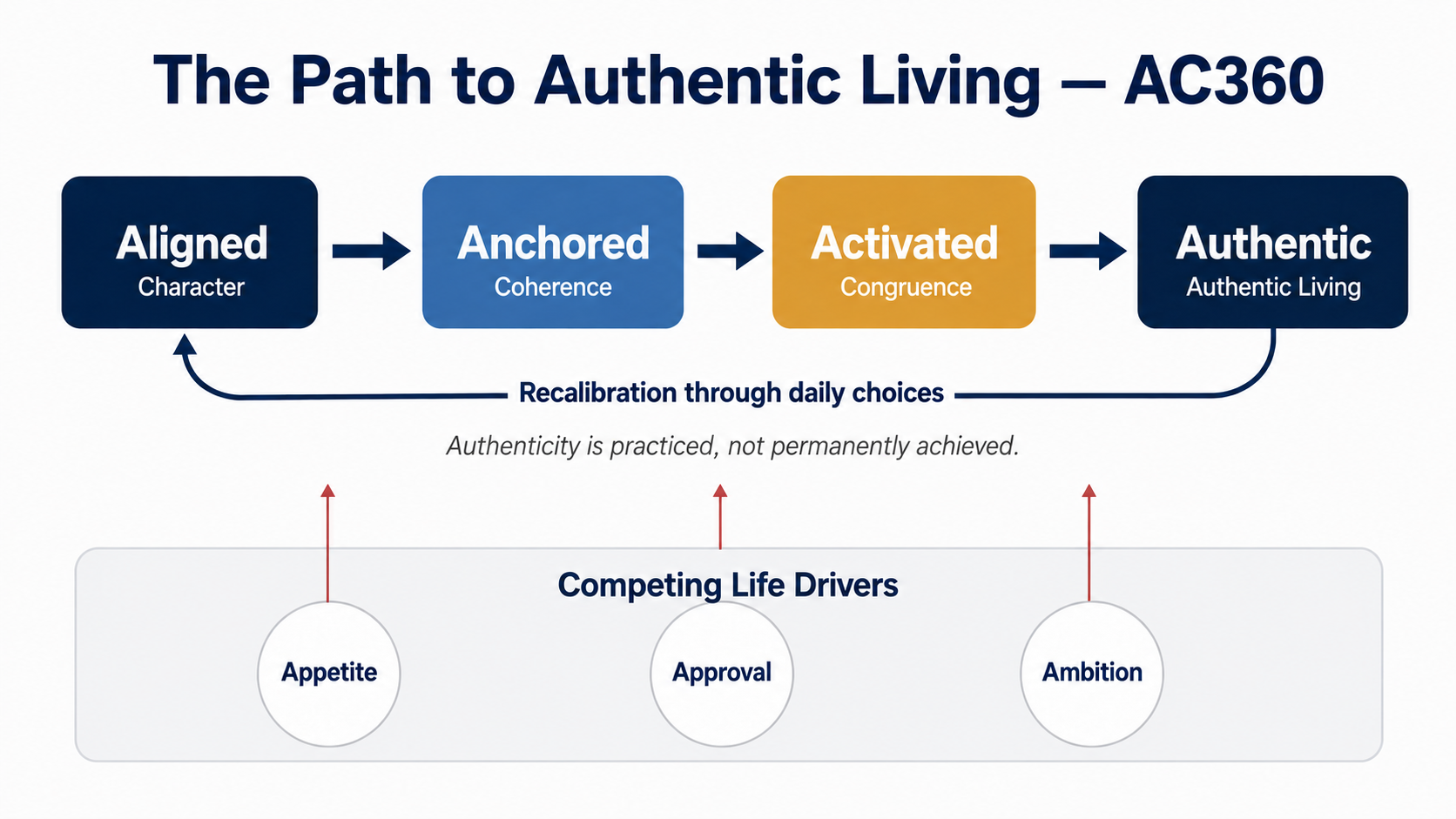
Character is not a plateau you reach. It is a rhythm you keep returning to. The AC formation arc describes four stages that every serious formation tradition has recognized. You will live in and out of these your whole life. Your Authentic360 report names your current center of gravity on the arc and the specific formation invitation your next season is asking you to walk.

The Path to Authentic Living, AC360 diagram. Aligned (Character) leads to Anchored (Coherence), then Activated (Congruence), then Authentic (Authentic Living). A recalibration arrow loops back to Aligned. Beneath, three Competing Life Drivers, Appetite, Approval, and Ambition, press upward against the arc.
The AC360 arc: four stages, one recalibration loop, three competing life drivers below.
AC-1

Aligned

The recognition

Understanding that character must be identified as a need. Recognizing that integrity requires an external plumb line, not a private conscience. Some people never take this first step.

AC-2

Anchored

The anchor named

Once you accept that character must be tied to something external, you have to answer: anchored to what? This is where a person commits to a specific plumb line. The choice is made; the daily living is uneven.

AC-3

Active

Practice

Now that the anchor is named, you begin to make it active in your words and actions. This is the deliberate, effortful phase. Over time and repetition, it becomes part of how you normally operate.

AC-4

Authentic

Discovered, not achieved

After sustained active living, authenticity is what you discover has taken root. You did not achieve it as a goal. It emerged as fruit. And the work is not done. You continue for the rest of your life to live in and out of authenticity.

Nine layers. One coherent portrait.

The Authentic360 report integrates all nine into a single reading of who you are, how well you govern who you are, and where the specific work of formation is calling you next.

Take the Authentic360 Assessment